

Open ultrasound research platform
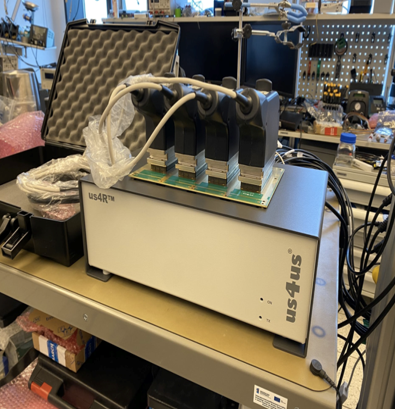
Open ultrasound research platform |
|
| description: | A new open multi-channel ultrasound research platform developed by the Polish Academy of Sciences. Based on the rapid improvement of GPU chip computing performance, the implementation of new advanced processing methods (such as synthetic aperture, vector |
|---|---|
Detailed introduction:
us4us is a research platform optimized for software-defined ultrasound (SDR) and built around GPU processing. In 2017, we developed a high-density ultrasound front-end module (us4OEMTM) with 128TX/32RX channels, which can be used as a building block for an expandable ultrasound scanner. Today, we introduce us4RTM, an advanced 2D and 3D ultrasound data acquisition and real-time processing platform.
us4RTM is a major upgrade to the original ultrasound platform system. The electronic solution it uses not only provides improved analog signal conditioning (better signal-to-noise ratio, higher sampling rate, etc.), but also improves the digital throughput of the original RF data collection. At the same time, the platform is quite small and consumes less power.
us4RTM is the number of scalable TX and RX channels-with 128-1024TX and 128-256 RX. The system* supports the connection of 1024-unit area array probes, providing new possibilities for real-time 3D. The ultrasonic data acquisition subsystem is optimized and upgraded through the PCIe gen3 interface. For applications, the system can support two PCIe 16-lane data links to external PCs-resulting in an aggregate data bandwidth of 32GB/s. Direct access to raw radio frequency data (such as channel data) and real-time software processing on GPU provide many possibilities for the research and evaluation of ultrasound algorithms and methods. The system is fully software programmable-including sending/receiving schemes and processing functions.
The software tool CUDA/OpenCL can be used to develop and integrate new algorithms into the processing framework of the platform. us4RTM can be used for the research and development of medical imaging and non-destructive testing applications, and as an educational tool and demonstration platform
Detailed parameters:
TX
Number of channels: 256
Center frequency: 0-20MHz
Delay resolution: 7.5ns
Programmable pulse transmitter voltage: 180Vpp plus or minus 2A
Maximum pulse repetition frequency: 100KHz
RX
Number of channels: 256
Frequency range: 0-50MHz
Programmable anti-aliasing filter: 10, 15, 20, 30, 50MHz
Amplifier gain:
Programmable LNA: 24, 18, 12db
Voltage controlled attenuator: 40db
Programmable amplifier gain: 24, 30db
Total signal chain gain: 54db (maximum)
TGC update rate: 1MHz
RF sampling: 12 bits @80MSPS
Raw data buffer: 128MB per channel
External synchronization
Sensor:
Number of sensor probes: 1-2
Probe: ESAOTE, VERMON, ULTRASONIX
Customized probe: Any ultrasound probe can be connected with a custom-designed PVCB module, and a corresponding probe adapter can be provided.
Raw RF data stream data rate: 2x16GB/s PCIe3.0
PC configuration:
One host
CPU: Single/Dual Intel@Xeon
RAM:>=32GB
GPU socket: 1-2
PCIe socket: 1-2
Software Development Kit:
API support: C/C++, python, Matlab
Advanced processing framework: TBD
GPU core (can be used directly): SAT, PWI, BFR

 Scan QR Code & Subscribe