

AOD Multiphoton Random Scanning Microscope
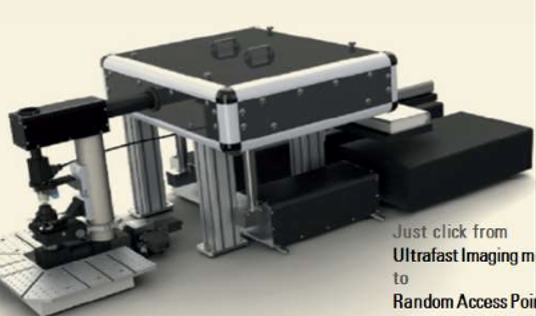
AOD Multiphoton Random Scanning Microscope |
|
| description: | French KARTHALA AOD multiphoton random scanning microscope. Optogenetics is a technology that integrates multiple disciplines such as optics, software control, gene manipulation technology, and electrophysiology. Since 2005, the Karl Deisseroth laboratory |
|---|---|
Detailed introduction:
The whole set of equipment is equipped with three acousto-optic deflectors and four PMTs. It is equipped with two channel systems to achieve in vivo and in vitro imaging, one for stimulation and one for imaging. We are currently the only ultrafast two-photon microscope that can image the function of genetically encoded voltage indicators (GEVI) and has the advantages of high resolution, high throughput, and non-invasiveness. The experimental subjects include fruit flies, zebrafish, rats and mice, etc... We image the action potentials of the awake mouse brain to reflect the changes in the action potentials of nerve fibers.
Product Features:
At present, most of the neurological instruments in the world are mainly used to detect calcium ions, and we are not only calcium ions imaging, but also nerve voltage indicator imaging. This cannot be done by other manufacturers in the market. The AOD multi-photon random scanning microscope system scans and detects neural action potentials in the true sense. With AOD multi-photon random scanning, it is finally able to explore the relationship between specific neural circuits and brain functions.
Detailed parameters:
Full-field imaging:
Non-mechanical ultra-fast scanning 10KHz/line
The dwell time in the entire field of view is constant and adjustable
Optogenetics two-photon scanning:
ROI imaging:
Free to choose ROIs
The flight speed between ROIs is 10us
Optogenetic scanning detection system:
Any access point
Freely selectable POIs up to 100KHz/POI
Pointing and repeatability below 10nm
Optogenetics two-photon scanning:
Random access area
Ultra-fast local volume excitation (ULOVE)
20KHz/Vols
Holographic volume expansion
Reduce live motion artifacts
Improve the efficiency of optogenetic stimulation

 Scan QR Code & Subscribe