
logo
×

PRODUCTS

Automated Fruit Fly Feeding Behavior Detection System
  • You Are Here :HOME > PRODUCTS > Automated Fruit Fly Feeding Behavior Detection System >
  • Automated Fruit Fly Feeding Behavior Detection System

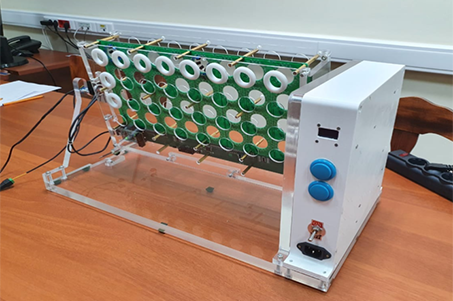
    description: The Automated Fruit Fly Feeding Behavior Detection System is an automated behavioral analysis instrument designed for fruit fly locomotion and exercise endurance research. By programmatically controlling the rotation of fruit fly culture tubes, the system
    Product Advantages
    The key advantage of the Automated Fruit Fly Feeding Behavior Detection System is its ability to transform fruit fly exercise experiments from manually operated procedures into an automated, programmable, and standardized workflow. The system allows precise control of exercise intensity, duration, interval cycles, and rest periods, ensuring consistent experimental conditions across different groups. It supports simultaneous operation of multiple samples and is suitable for long-term exercise training experiments and large-scale genetic screening studies, enabling researchers to accurately evaluate the effects of exercise on behavior, lifespan, metabolism, and gene function.
    The Fruit Fly Feeding Behavior Detection Module uses high-sensitivity sensing technology to monitor feeding events in real time, enabling quantitative analysis of feeding frequency, feeding duration, and food preference

    The Optogenetic Closed-Loop Control Module enables real-time behavioral event detection and precise optical stimulation to investigate the causal relationship between neural activity and behavior.

    Main Product Features
    Automated Exercise Training Mode
    The system uses motor-driven rotation of culture tubes to provide programmed exercise stimulation, allowing continuous fruit fly training without daily manual operation.
    Programmable Exercise Parameter Control
    Users can customize rotation speed, exercise duration, interval cycles, and rest periods according to experimental requirements, enabling different exercise intensity protocols.
    Based on Natural Fruit Fly Behavioral Mechanisms
    The system utilizes the natural negative geotaxis behavior of fruit flies, inducing climbing activity through controlled environmental rotation without additional external stimulation.
    Multi-Sample Experimental Capability
    The system supports simultaneous operation of multiple fruit fly culture tubes, improving experimental efficiency and enabling large-scale behavioral studies.
    Suitable for Long-Term Exercise Studies
    The platform supports continuous exercise training experiments for investigating the effects of exercise on lifespan, metabolism, and age-related functional changes.
    Compatible with Standard Fruit Fly Culture Tubes
    The system is designed to work with commonly used fruit fly culture tubes, simplifying laboratory implementation.
    Improved Experimental Reproducibility
    Automated operation reduces variations caused by manual handling and ensures consistent experimental conditions across different studies.
    Application Areas
    Fruit Fly Exercise Physiology Research
    Used to investigate the effects of exercise training on physical performance, locomotor ability, and physiological functions in fruit flies.
    Aging and Lifespan Research
    Applied to study how exercise interventions influence lifespan, aging progression, and age-related functional decline.
    Metabolism Research
    Used to explore the effects of exercise on energy metabolism, nutrient utilization, and metabolism-related gene regulation.
    Neuroscience Research
    Applied to investigate neural regulation of locomotor behavior, movement performance, and behavioral phenotypic differences.
    Genetics Research
    Combined with genetically modified fruit fly models to study the effects of specific genes on locomotion, endurance, and behavioral traits.
    Disease Model Research
    Used in studies of movement-related disease models, including neurodegenerative disorders and muscle function-related conditions.
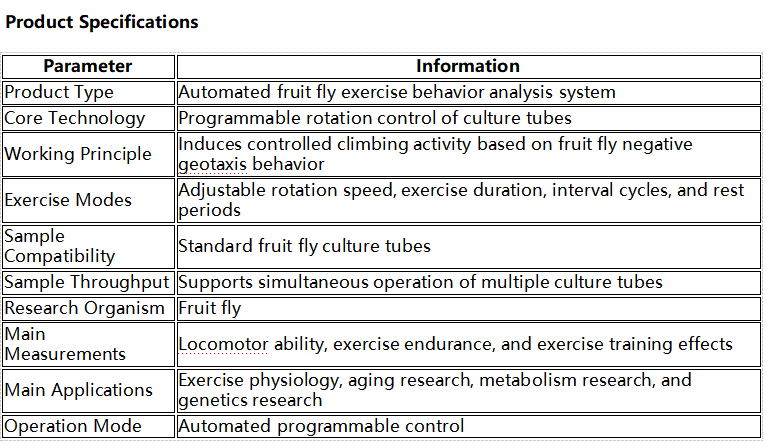
    Detailed Specifications