Hydroporator Microfluidic Cell Transfection Platform
Hydroporator Microfluidic Cell Transfection Platform
|
| description: |
Hydroporator is a non-viral microfluidic platform for highly effective delivery of external cargos such as plasmid DNA, mRNA, proteins, CRISPR-Cas9 RNPs, and nanoparticles into primary cells. The Hydroporator technology enables high delivery efficiency, eas |
Basic Information
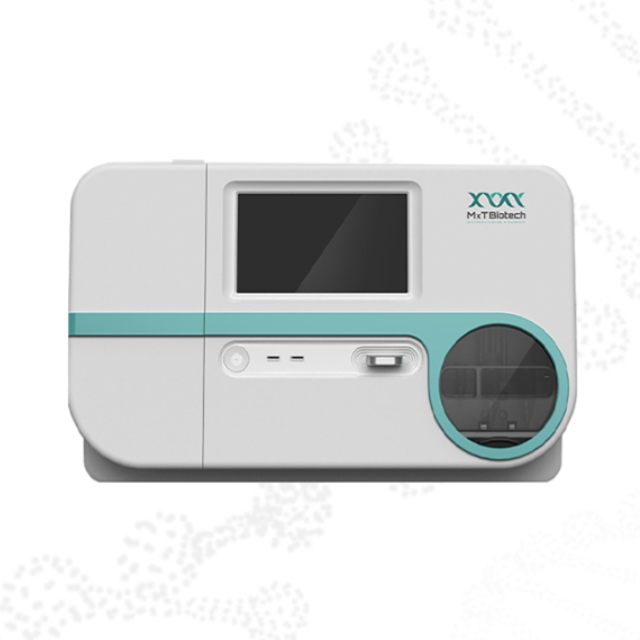
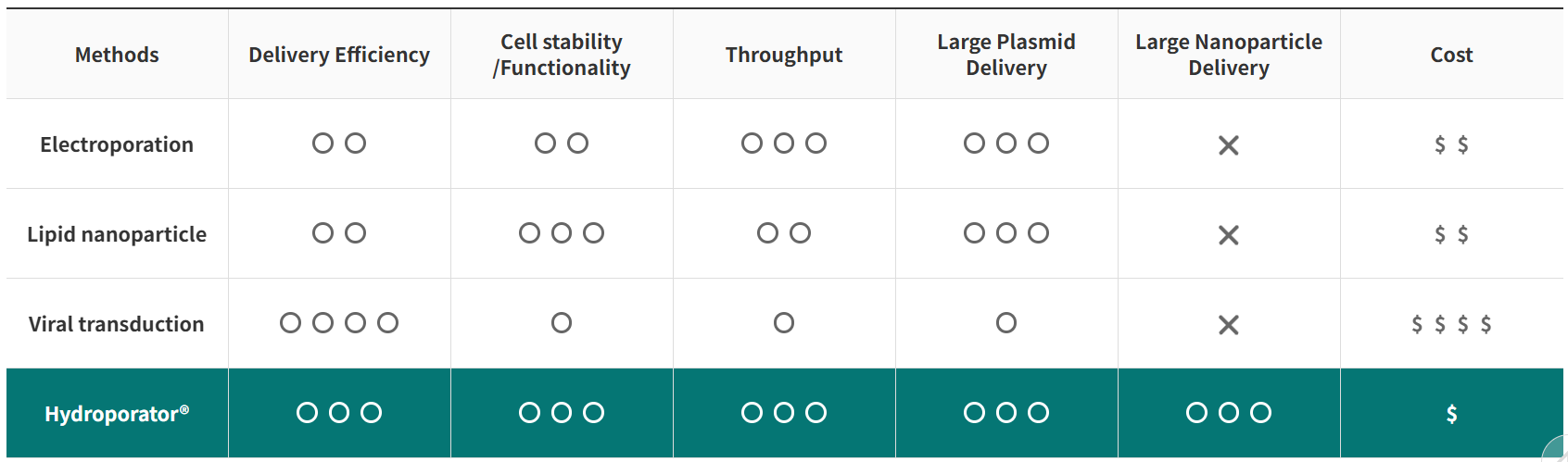
Hydroporator is a non-viral microfluidic platform for highly effective delivery of external cargos such as plasmid DNA, mRNA, proteins, CRISPR-Cas9 RNPs, and nanoparticles into primary cells. The Hydroporator technology enables high delivery efficiency, easy operation, low cost, high scalability, minimal cell perturbation (i.e., preserved cell function and viability), and cell type/cargo insensitive delivery. Hydroporator is free from the challenges from viral transduction, lipofection and electroporation, establishing a new avenue to accelerate cancer immunotherapy, cellular engineering and genome editing.
 Product Advantages:
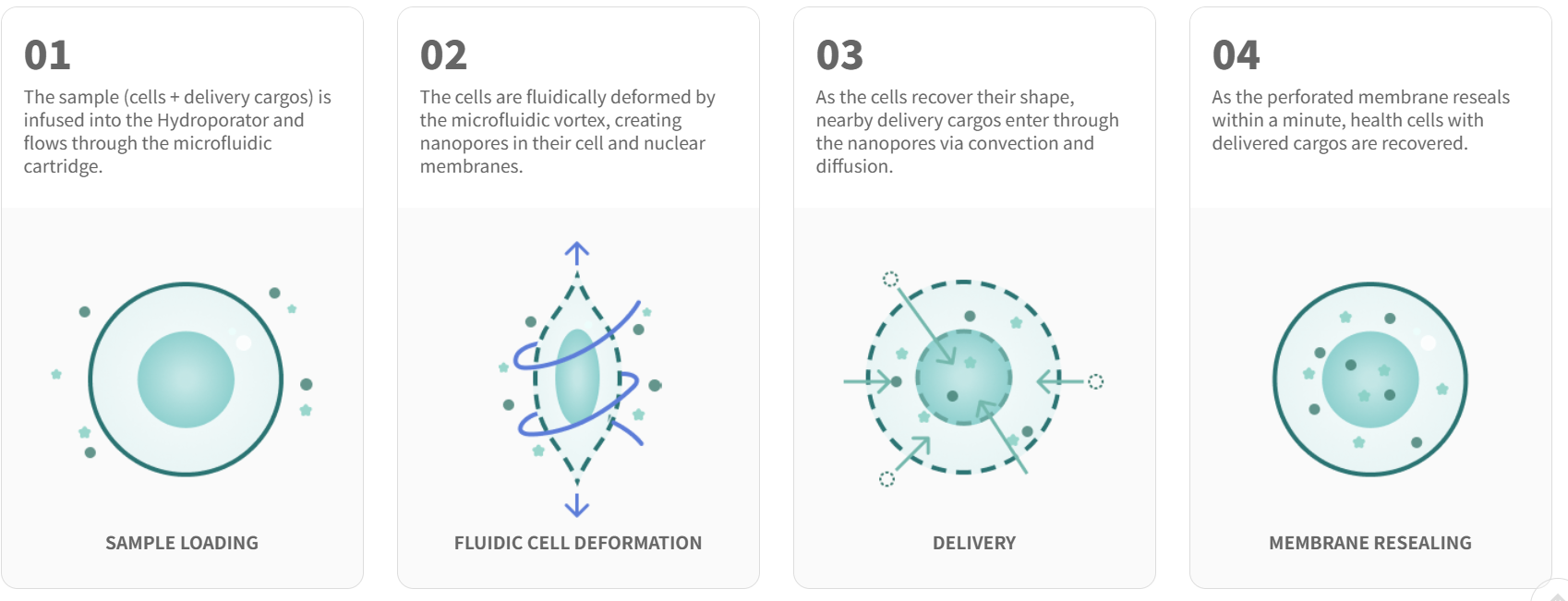
1.Hydrodynamic flow enables efficient and gentle transfection without chemical reagents.
2.Fully automated operation supports consistent and high-throughput experiments.
3.Precise microfluidic control ensures uniform transfection across all cells.
4.Compatible with various cell types and cargos including DNA, RNA, and proteins.
5.Closed and sterile workflow minimizes contamination risk.
6.Real-time monitoring maintains optimal transfection conditions.
7.Compact design and intuitive interface simplify laboratory integration.
Product Advantages:
1.Hydrodynamic flow enables efficient and gentle transfection without chemical reagents.
2.Fully automated operation supports consistent and high-throughput experiments.
3.Precise microfluidic control ensures uniform transfection across all cells.
4.Compatible with various cell types and cargos including DNA, RNA, and proteins.
5.Closed and sterile workflow minimizes contamination risk.
6.Real-time monitoring maintains optimal transfection conditions.
7.Compact design and intuitive interface simplify laboratory integration.
 Main Product Features:
1. Broad Compatibility with Diverse Cell Types
Hydroporator® RUO is optimized for a wide range of cells, from immortalized cell lines to hard-to-transfect primary cells and stem cells. Its hydrodynamic delivery mechanism provides high efficiency across both adherent and suspension cells.
2. High Viability and Low Cytotoxicity
Unlike electroporation or chemical transfection, the hydrodynamic approach maintains excellent cell viability. This makes it especially suitable for sensitive cells such as primary immune cells, neurons, and iPSCs.
3. Efficient Delivery of Multiple Cargo Types
The system can deliver various biomolecules — including plasmid DNA, mRNA, siRNA, proteins, and nanoparticles — into mammalian cells with high reproducibility and minimal cell stress.
4. Optimized Protocols for Each Cell Category
Pre-installed and customizable transfection protocols are available for different cell types. Users can quickly select the appropriate settings without tedious parameter optimization.
5. Excellent Scalability for Research and Screening
Hydroporator® RUO supports both small-scale validation experiments and large-scale transfection studies, making it ideal for research in gene editing, drug discovery, and cell therapy development.
6. Consistent Results across Multiple Cell Lines
The microfluidic control ensures uniform shear stress and flow exposure, providing reproducible transfection efficiency and expression levels across experiments and cell batches.
Main Product Features:
1. Broad Compatibility with Diverse Cell Types
Hydroporator® RUO is optimized for a wide range of cells, from immortalized cell lines to hard-to-transfect primary cells and stem cells. Its hydrodynamic delivery mechanism provides high efficiency across both adherent and suspension cells.
2. High Viability and Low Cytotoxicity
Unlike electroporation or chemical transfection, the hydrodynamic approach maintains excellent cell viability. This makes it especially suitable for sensitive cells such as primary immune cells, neurons, and iPSCs.
3. Efficient Delivery of Multiple Cargo Types
The system can deliver various biomolecules — including plasmid DNA, mRNA, siRNA, proteins, and nanoparticles — into mammalian cells with high reproducibility and minimal cell stress.
4. Optimized Protocols for Each Cell Category
Pre-installed and customizable transfection protocols are available for different cell types. Users can quickly select the appropriate settings without tedious parameter optimization.
5. Excellent Scalability for Research and Screening
Hydroporator® RUO supports both small-scale validation experiments and large-scale transfection studies, making it ideal for research in gene editing, drug discovery, and cell therapy development.
6. Consistent Results across Multiple Cell Lines
The microfluidic control ensures uniform shear stress and flow exposure, providing reproducible transfection efficiency and expression levels across experiments and cell batches.
 Application Areas:
Gene Editing
Enables efficient delivery of CRISPR components for precise genome modification in various cell types.
Gene Therapy
Supports non-viral gene delivery methods for safer and reproducible therapeutic development.
Regenerative Medicine
Facilitates transfection of stem cells and iPSCs to study tissue repair and regeneration.
Cell Therapy
Delivers genes or mRNA into immune cells such as T cells for CAR-T or engineered cell therapy.
Cell Engineering
Provides a platform for modifying cell function through gene or protein delivery.
Cell Line Development
Enables stable and reproducible transfection for generation of engineered cell lines.
CRISPR Genome Editing in T Cells
Efficiently edits endogenous genes such as TCR and PD-1 in human T cells.
mRNA-based CAR-T Cell Manufacturing
Offers a non-viral method for producing mRNA-CAR-T cells with high viability.
For research use only.
Application Areas:
Gene Editing
Enables efficient delivery of CRISPR components for precise genome modification in various cell types.
Gene Therapy
Supports non-viral gene delivery methods for safer and reproducible therapeutic development.
Regenerative Medicine
Facilitates transfection of stem cells and iPSCs to study tissue repair and regeneration.
Cell Therapy
Delivers genes or mRNA into immune cells such as T cells for CAR-T or engineered cell therapy.
Cell Engineering
Provides a platform for modifying cell function through gene or protein delivery.
Cell Line Development
Enables stable and reproducible transfection for generation of engineered cell lines.
CRISPR Genome Editing in T Cells
Efficiently edits endogenous genes such as TCR and PD-1 in human T cells.
mRNA-based CAR-T Cell Manufacturing
Offers a non-viral method for producing mRNA-CAR-T cells with high viability.
For research use only.
Detailed Specifications
Specification
Usage: For Research Use Only
Scale: Laboratory (Research) scale
Cell Capacity: Up to 10 million cells per run
Delivery Efficiency: High delivery efficiency with preserved cell viability and functionality
Protocols: Pre-loaded and adjustable protocols for various cell types and cargo
Software: Intuitive software UI with customizable options
Cartridge Compatibility: Compatible with HP-L and HP-S cartridges
System Type: Fully automated system
Reagent Requirement: No additional reagents required for processing
Design: Compact size, ergonomically designed for optimal user environment
Consumables: Compatible with standard laboratory consumables
Sterility: Sterile packaging for cartridges
Cleaning: Cleaning cartridge included



 Scan QR Code & Subscribe