Dynamic Physiological Microenvironment Barrier-on-Chip System
Dynamic Physiological Microenvironment Barrier-on-Chip System
|
| description: |
Organs-on-Chip are bioengineered in vitro models that closely mimic the structure and function of human organs. By modelling the smallest functional unit of the organ, they enable the simulation of human physiology. Organs-on-chip will reduce drug attriti |
Basic Information
Organs-on-Chip are bioengineered in vitro models that closely mimic the structure and function of human organs. By modelling the smallest functional unit of the organ, they enable the simulation of human physiology. Organs-on-chip will reduce drug attrition rate and animal testing.
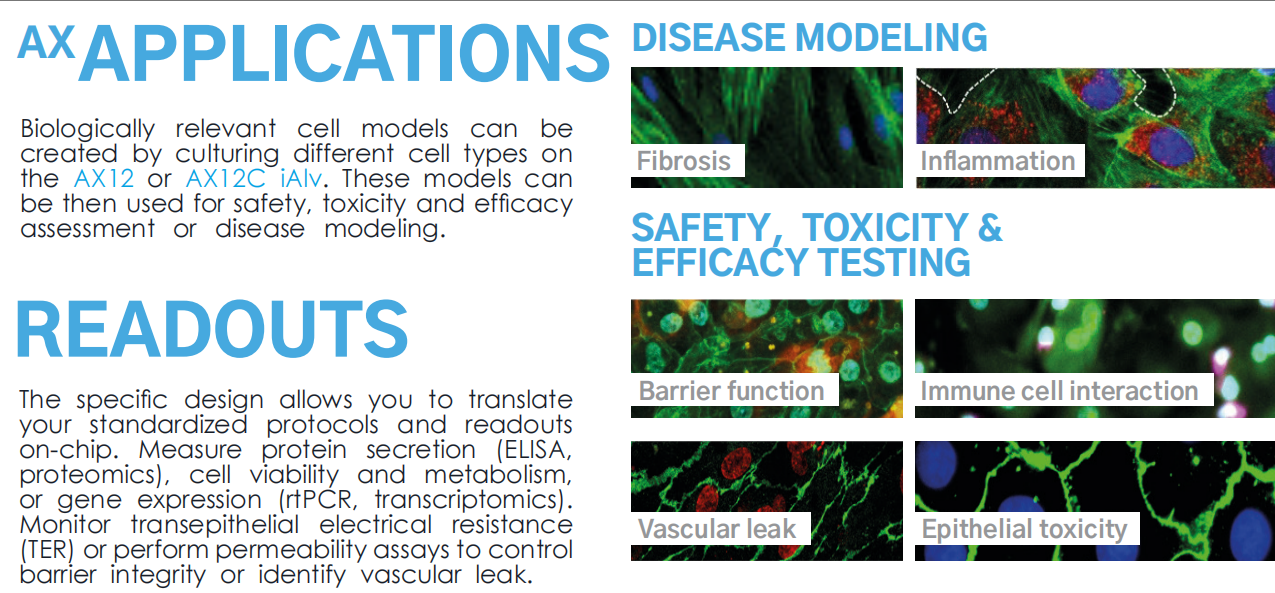
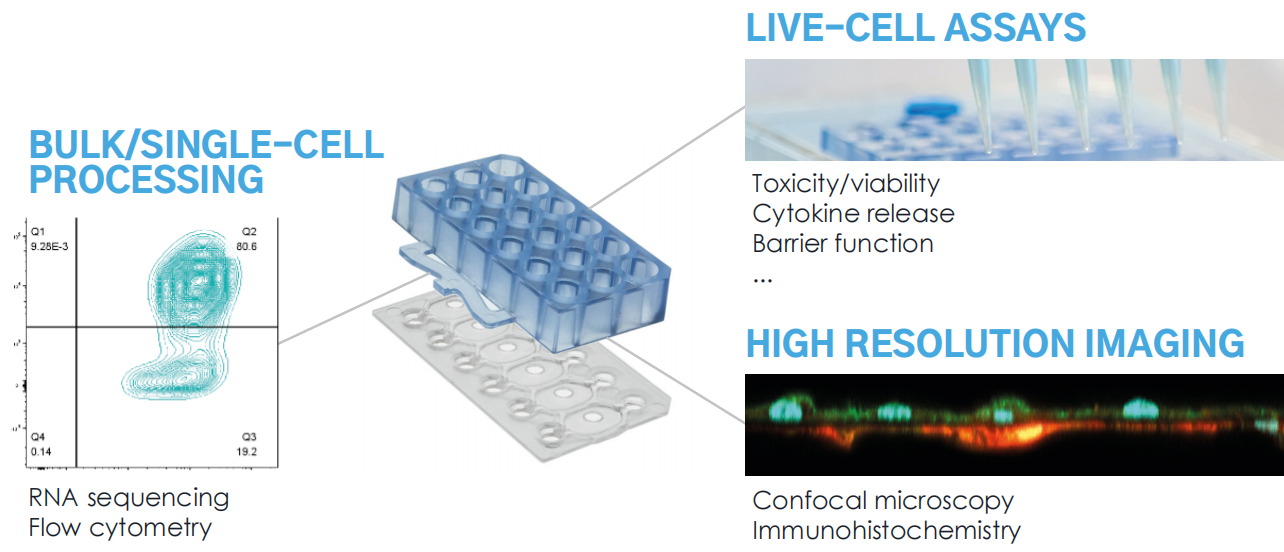
Our barrier-on-chip allows the modeling of a wide range of tissue barriers. The soft cell culture substrate facilitates cell attachment and the establishment of tight mono- and co-cultures.
At AlveoliX, everything is engineered to be “as simple as possible, but not simpler”. Inspired by nature, we develop our organs-on-chip by combining expertise in microfluidics and cell biology. The innovative chip design allows accurate cell seeding, easy multi-time point sampling, and barrier integrity measurements. It is perfectly suitable for modeling various tissue barriers such as lung, gut, skin, brain, kidney, etc. using cell lines, induced pluripotent stem, or primary cells
 Product Advantages:
1.Highly Biomimetic with Physiological Mechanical Simulation
Accurately replicates human organ microenvironments, including gas exchange, nutrient flow, and mechanical stretching (e.g., lung breathing).
2.Reduction in Animal Testing, Enhanced Predictive Power
Offers more reliable preclinical results compared to traditional 2D/3D cultures; improves drug efficacy and toxicity predictions.
3.High-Throughput and Precision Control
Microfluidic systems allow fine-tuned control over shear stress, pressure gradients, and flow rates, enabling standardization and scalability.
Product Advantages:
1.Highly Biomimetic with Physiological Mechanical Simulation
Accurately replicates human organ microenvironments, including gas exchange, nutrient flow, and mechanical stretching (e.g., lung breathing).
2.Reduction in Animal Testing, Enhanced Predictive Power
Offers more reliable preclinical results compared to traditional 2D/3D cultures; improves drug efficacy and toxicity predictions.
3.High-Throughput and Precision Control
Microfluidic systems allow fine-tuned control over shear stress, pressure gradients, and flow rates, enabling standardization and scalability.
 Main Product Features:
The AXBarrier-on-Chip System includes customizable stretch parameters to replicate mechanical cues of any organ barrier.
Uni- or Bidirectional membrane movement --Create any motion pattern of your choice
Physiological and Pathophysiological stretch levels --Create physiological motion or simulate traumas / injuries
Frequency adjustments--Speed up or slow down the motion to target the desired stimuli
Active and dormant time periods definition --Tune the organ motion to account for day and night activit
Ultrathin, porous and elastic membrane for cell growth --Thickness: 3.5µm & Pores: Ø 3µm
Mono- or Coculture models--with/without immune component
Application Areas:
Drug screening and toxicity testing
Disease modeling and mechanism studies
Precision medicine and personalized drug response
Alternatives to animal testing
Multi-organ interaction studies and pharmacokinetics modeling
Main Product Features:
The AXBarrier-on-Chip System includes customizable stretch parameters to replicate mechanical cues of any organ barrier.
Uni- or Bidirectional membrane movement --Create any motion pattern of your choice
Physiological and Pathophysiological stretch levels --Create physiological motion or simulate traumas / injuries
Frequency adjustments--Speed up or slow down the motion to target the desired stimuli
Active and dormant time periods definition --Tune the organ motion to account for day and night activit
Ultrathin, porous and elastic membrane for cell growth --Thickness: 3.5µm & Pores: Ø 3µm
Mono- or Coculture models--with/without immune component
Application Areas:
Drug screening and toxicity testing
Disease modeling and mechanism studies
Precision medicine and personalized drug response
Alternatives to animal testing
Multi-organ interaction studies and pharmacokinetics modeling
 Specification
About Exchanger
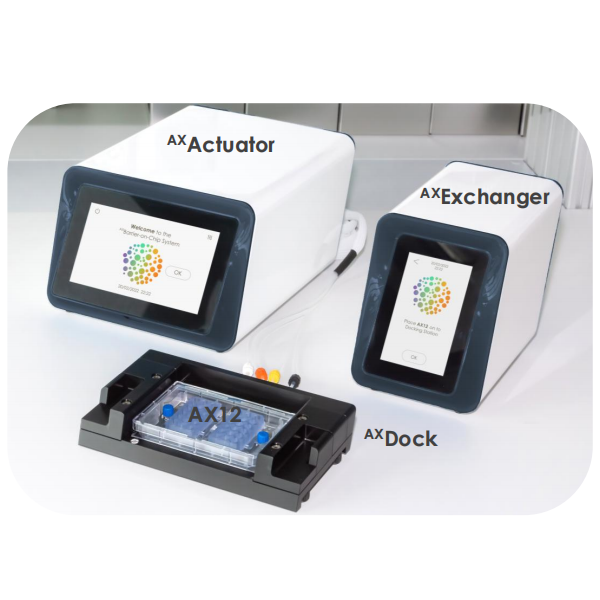
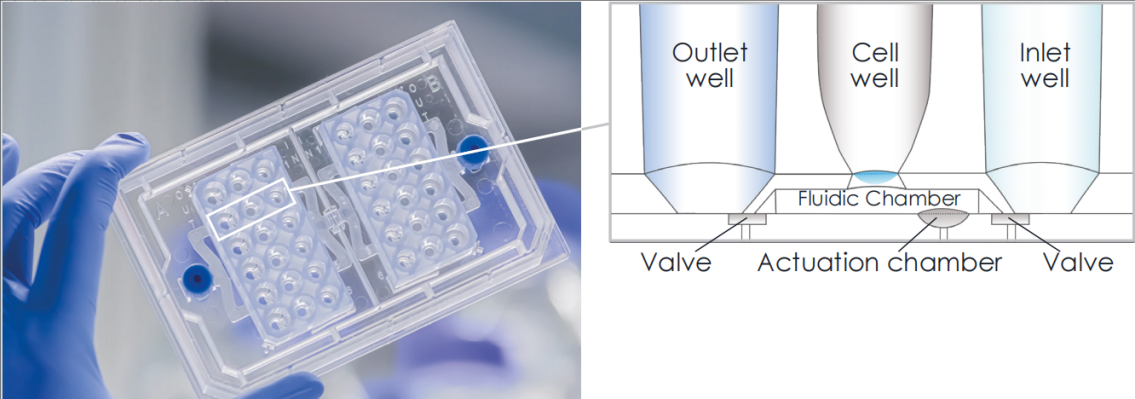
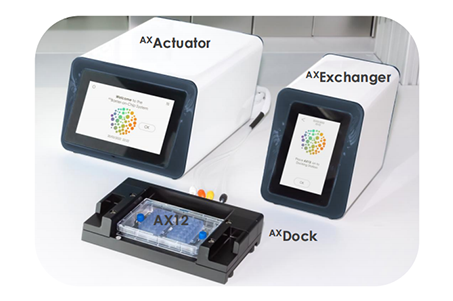
The AXExchanger is connected to the AXDock inside the cell culture hood. It pneumatically controls the valves of the AX12, located between the inlet well, the cell culture chamber and the outlet well. By opening and closing the valves, a controlled fluid flow is created for initial chip filling and medium exchange. The AXExchanger also allows the measurement of TEER in combination with a suitable equipment. It is operated via a touch screen interface and an intuitive software.
About AXActuator
The AXActuator is connected to the second AXDock placed in the incubator. It pneumatically controls the movement of the membrane inside the AX12, recreating the cyclic stretch motion. The parameters can be easily modified in the interface. The AXActuator is controlled via a touch screen interface and an intuitive software. Experimental data can be exported to a USB flash drive for documentation.
About Chip Membrane
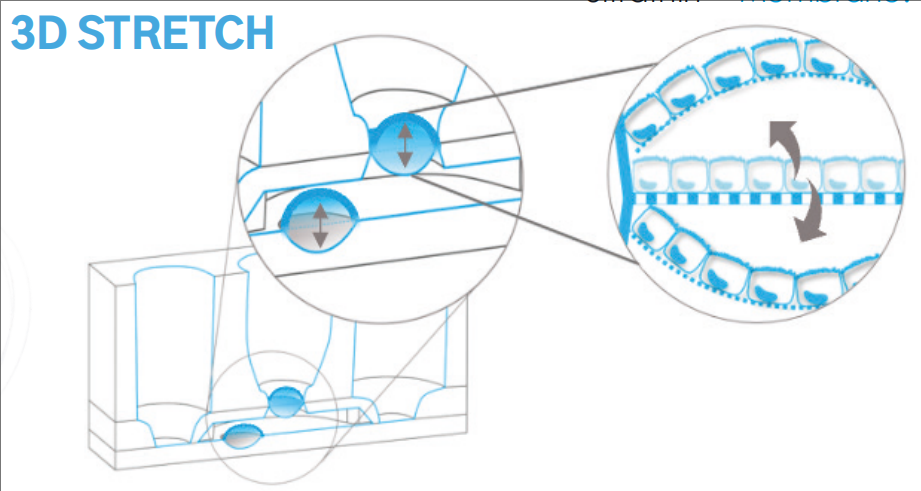
The elastic and ultrathin membrane is a key component of our lung-on-chip. It enables the 3D cyclic stretch and serves as a soft cell culture support for optimal cell attachment. Our biocompatible silicone membrane allows many different ECM coatings. The 3.5 μm thin membrane has 3 μm pores at a density of 800000 pores/cm2.
About Breathing Motion
Our patented 3D breathing concept applies human lung physics. The ultrathin membrane is deflected by negative pressure inside the basal chip chamber through an integrated micro-diaphragm. In this way, cells cultured on the membrane get constantly stretched and biomechanically stimulated.
Specification
About Exchanger
The AXExchanger is connected to the AXDock inside the cell culture hood. It pneumatically controls the valves of the AX12, located between the inlet well, the cell culture chamber and the outlet well. By opening and closing the valves, a controlled fluid flow is created for initial chip filling and medium exchange. The AXExchanger also allows the measurement of TEER in combination with a suitable equipment. It is operated via a touch screen interface and an intuitive software.
About AXActuator
The AXActuator is connected to the second AXDock placed in the incubator. It pneumatically controls the movement of the membrane inside the AX12, recreating the cyclic stretch motion. The parameters can be easily modified in the interface. The AXActuator is controlled via a touch screen interface and an intuitive software. Experimental data can be exported to a USB flash drive for documentation.
About Chip Membrane
The elastic and ultrathin membrane is a key component of our lung-on-chip. It enables the 3D cyclic stretch and serves as a soft cell culture support for optimal cell attachment. Our biocompatible silicone membrane allows many different ECM coatings. The 3.5 μm thin membrane has 3 μm pores at a density of 800000 pores/cm2.
About Breathing Motion
Our patented 3D breathing concept applies human lung physics. The ultrathin membrane is deflected by negative pressure inside the basal chip chamber through an integrated micro-diaphragm. In this way, cells cultured on the membrane get constantly stretched and biomechanically stimulated.
Detailed Specifications
Specification
About Exchanger
The AXExchanger is connected to the AXDock inside the cell culture hood. It pneumatically controls the valves of the AX12, located between the inlet well, the cell culture chamber and the outlet well. By opening and closing the valves, a controlled fluid flow is created for initial chip filling and medium exchange. The AXExchanger also allows the measurement of TEER in combination with a suitable equipment. It is operated via a touch screen interface and an intuitive software.
About AXActuator
The AXActuator is connected to the second AXDock placed in the incubator. It pneumatically controls the movement of the membrane inside the AX12, recreating the cyclic stretch motion. The parameters can be easily modified in the interface. The AXActuator is controlled via a touch screen interface and an intuitive software. Experimental data can be exported to a USB flash drive for documentation.
About Chip Membrane
The elastic and ultrathin membrane is a key component of our lung-on-chip. It enables the 3D cyclic stretch and serves as a soft cell culture support for optimal cell attachment. Our biocompatible silicone membrane allows many different ECM coatings. The 3.5 μm thin membrane has 3 μm pores at a density of 800000 pores/cm2.
About Breathing Motion
Our patented 3D breathing concept applies human lung physics. The ultrathin membrane is deflected by negative pressure inside the basal chip chamber through an integrated micro-diaphragm. In this way, cells cultured on the membrane get constantly stretched and biomechanically stimulated.



 Scan QR Code & Subscribe