

ARGO Ultra-high Sensitive Biomaker Detection System
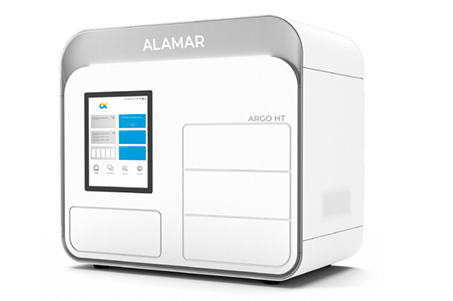
ARGO Ultra-high Sensitive Biomaker Detection System |
|
| description: | The ARGO System is a fully automated, high-throughput precision proteomics platform for ultra-high sensitivity analysis across a range of multiplex levels to support broad biomarker profiling and translation of validated biomarkers into clinical use. |
|---|---|
Basic Introduction:
The ARGO System is a fully automated, high-throughput precision proteomics platform for ultra-high sensitivity analysis across a range of multiplex levels to support broad biomarker profiling and translation of validated biomarkers into clinical use.
The NULISA™ Platform sets a new standard in proteomic analysis with attomolar sensitivity, allowing for unprecedented biomarker detection and quantitation. By leveraging a proprietary sequential immunocomplex capture and release mechanism and the latest advances in Next Generation Sequencing (NGS), the NULISA technology provides both ultra-high sensitivity and scalable multiplexing.
Product Advantages:
All-in-one instrument with integrated qPCR system takes you from sample to data or to pooled NGS library
Fully automated workflow with <30 min total hands-on time
High throughput capacity processes up to 288 samples per run
Rapid results in <6 hrs for single-plex assays and <15 hrs for multiplex NGS assays
Integrated software and data analysis transforms data into biological insights and publication-ready results
Application:
Biomedical Research: The platform can be employed to study the expression and regulation of proteins in various biological processes. Researchers can explore proteomic data to identify potential biomarkers, revealing insights into disease mechanisms, diagnostic methods, and therapeutic strategies.
Clinical Diagnosis and Monitoring: Precise proteomics platforms can aid in the development of diagnostic reagents for detecting disease biomarkers. This facilitates early diagnosis, disease subtyping, disease monitoring, and assessment of treatment responses.
Drug Development: These platforms can be used to investigate the interactions between drugs and proteins, assessing drug efficacy and toxicity, thereby guiding drug development and screening processes.
Personalized Medicine: Based on individual proteomic data, medical professionals can tailor personalized treatment plans to better meet patients' specific needs.
Cancer Research: These platforms also find extensive use in cancer biology research. They help identify tumor markers, recognize tumor subtypes, and unveil molecular mechanisms underlying tumors, thus guiding treatment choices.
Neuroscience Research: These platforms can be utilized to study protein expression and changes in the nervous system, contributing to an understanding of neurological disease mechanisms.
Metabolism Research: Proteomics platforms, when combined with metabolomics data, allow for an in-depth exploration of the relationship between metabolic pathways and protein regulation, enhancing our comprehension of metabolic diseases.
Specification
Dimensions (W x D x H): 1143 mm (45 in) x 1016 mm (40 in) x 661 mm (26 in)
Weight: ~ 192 kg
Power: North America: 100-120 VAC; 60 Hz, 20 Amps, Type B Outlet Europe: 220-240 VAC, 50 Hz, 10 Amps, Schuko Outlet
Working environment: Temperature: 17-28 C (59-88 F) Humidity: Up to 80%, non-condensation Altitude: Up to 2500 m (8200 ft.) Thermo output at typical power draw of 1,310 W: 4470 BTU/hr
Other Connections: 1 Gig Ethernet; 1 x USB 2.0; RJ45-type connector
Software: Instrument Control Software and Primary and Secondary Analysis Software included with System

 Scan QR Code & Subscribe