

Nanoparticle Analysis System
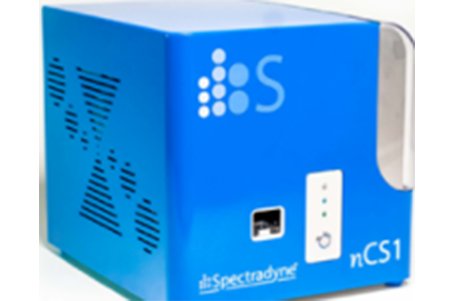
Nanoparticle Analysis System |
|
| description: | The nCS1 high-resolution nanoparticle analyzer launched by Spectradyne in the United States provides a platform for quantitative measurement of nanoparticles. When measuring nanoparticles, electrical properties are used to identify particles in a suspende |
|---|---|
Product introduction
The nCS1 high-resolution nanoparticle analyzer launched by Spectradyne in the United States provides a platform for quantitative measurement of nanoparticles. When measuring nanoparticles, electrical properties are used to identify particles in a suspended medium without relying on their optical parameters. The instrument can measure individual particles and integrate statistical data of particle size and quantitative concentration. This performance distinguishes nCS1 from other nanoanalyzers on the market.
Main features of nCS1
Resistance pulse sensing and the size measurement of a single nanoparticle in a fluid
Disposable microfluidic chip to avoid cross contamination
Report particle size distribution and concentration
Particle size: 40 nm to micron level
Concentration range: about 106-1012 pcs/mL
The detection speed of large particles: about 10,000 particles/mL
Nanoparticles of material type (transparent & opaque, conductive & insulating)
Desktop size
Linear power supply
Dimensions: 330 mm x 330 mm x 380 mm (length x width x height)
Weight: 14 kg
Instrument control interface: USB
Software
Unique signal extraction method
Linear process
Multi-dimensional data visualization
Fast concentration measurement within a certain size range
Automatic particle distribution analysis
Microfluidic chip
Spectradyne's nCS1 uses disposable nano-fabricated and analyzed microfluidic chips. These microfluidic devices are based on a nano-analysis technology: resistance pulse sensing. This technology electromagnetically detects the particles as they pass through the nano-extrusion one by one. When a single nanoparticle passes through the nano-extrusion, the electromagnetic resistance of the suspension liquid is increased, and a short voltage pulse is generated. The size of the pulse is positively related to the volume of the nanoparticle. The amplitude and duration of the pulse determine the particle size and average velocity. Microfluidic chips of different sizes can cope with nanoparticles of different sizes, and the particle size can range from 40 nm to micrometers.
Concentration Spectral Density (CSD)
Through software analysis, the measurement results of a large number of particle diameters are made into a histogram, and the vertical axis is set as the concentration of nanoparticles. After removing the dependence of the histogram width, the unit of concentration spectral density (CSD) is particles·mL-1·nm-1. Due to the measurement capability of nCS1, data can be obtained within a few seconds.
Material universality
Spectradyne's nCS1 can provide accurate and efficient particle size and concentration analysis for nanoparticles of any material. Resistance pulse sensing can be applied to particles of different materials, such as gold nanoparticles with the same size, virus and lipid nanoparticles, all of which can give the same results.
Advantage
Spectradyne's nCS1 is a benchtop technology that provides high-resolution size distribution and accurate concentration measurement, with a detection range of 40-10000 nm. The instrument uses only electronic sensors, no optical components, and quickly counts and determines the size of individual nanoparticles with an accuracy of a few percent. nCS1 can analyze any type of nanoparticles, and the results are accurate and representative. Provides an orthogonal technology for optical-based particle analyzers.

 Scan QR Code & Subscribe