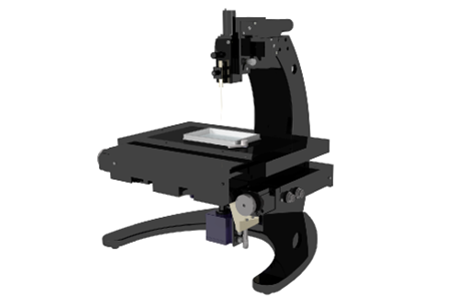
Netherland LSM Automatic high-throughput zebrafish embryo microinjection system
Netherland LSM Automatic high-throughput zebrafish embryo microinjection system
|
| description: |
LSM is the world's first truly high flux automatic zebrafish micromanipulation injection device, the birth of it can completely satisfy the demand for high-throughput embryos or cell injection and liberation experiment operator's hands, let the microinje |
Overview:
LSM is the world's first truly high flux automatic zebrafish micromanipulation injection device, the birth of it can completely satisfy the demand for high-throughput embryos or cell injection and liberation experiment operator's hands, let the microinjection become more simple, rapid, accurate!

 LSM System technical characteristics:
High throughput, 2500 embryos per hour, fully automatic without manual injection
Quantitative injection, high repeatability, convenient for comparative study
Rapid detection typically takes three to seven days, rather than weeks using other technologies
Accurate and automatic 3D positioning, convenient and fast, can achieve efficient automatic imaging (compatible with confocal microscope, etc.)
Cultured cells can be spherical in 3D and cultured using cell lines or progenitor cells
The tumor microenvironment can be studied. Spheroids can introduce environments into preformed microcrystals, such as cells mixed with collagen
Studies of intercellular interactions, such as cancer and immune cells, bacteria and immune cells
Application of zebrafish embryo microinjection:
1. High-throughput zebrafish embryo injection: the agarose gel is injected into the mold to form an agar-agar grid used to align zebrafish embryos. For injection, different sizes of mesh can be selected according to different sample batches required by the experiment, such as 2580 mesh, 1024 mesh and 9x 100 mesh. It takes less than five minutes to put an embryo into a mold. The quality of the injection is guaranteed by our machines at the closest point to the surface of the fertilized egg and yolk.
2. 3D cell culture, cell globules: first, collagen, or another hydrogel, is sucked into a porous plate and allowed to be set up. A single cell suspension was then prepared from cell culture or primary tissue. The suspension is mixed with an inert polymer, the PVP, and loaded into a needle. Finally, the cells suspended in a predetermined position are injected into the hydrogel. A typical test is incubated for 3 to 7 days, which can be pathologically treated with standard/confocal microscopy, or sampled by flow cytometry. The reproducible injection position allows imaging of all holes in the same position. The size of the sphere (~300 centile, ~10k cells) and the outer growth of the sphere are replicable, making it an option for active screening for migration, proliferation, etc.
3. Cell injection: the injection is done at precise locations, so different cell types can be injected at reproducible distances. These injections can be administered at different times to accommodate different growth rates or time-dependent biological interactions. A lot of mixed culture analysis is developing.
LSM System technical characteristics:
High throughput, 2500 embryos per hour, fully automatic without manual injection
Quantitative injection, high repeatability, convenient for comparative study
Rapid detection typically takes three to seven days, rather than weeks using other technologies
Accurate and automatic 3D positioning, convenient and fast, can achieve efficient automatic imaging (compatible with confocal microscope, etc.)
Cultured cells can be spherical in 3D and cultured using cell lines or progenitor cells
The tumor microenvironment can be studied. Spheroids can introduce environments into preformed microcrystals, such as cells mixed with collagen
Studies of intercellular interactions, such as cancer and immune cells, bacteria and immune cells
Application of zebrafish embryo microinjection:
1. High-throughput zebrafish embryo injection: the agarose gel is injected into the mold to form an agar-agar grid used to align zebrafish embryos. For injection, different sizes of mesh can be selected according to different sample batches required by the experiment, such as 2580 mesh, 1024 mesh and 9x 100 mesh. It takes less than five minutes to put an embryo into a mold. The quality of the injection is guaranteed by our machines at the closest point to the surface of the fertilized egg and yolk.
2. 3D cell culture, cell globules: first, collagen, or another hydrogel, is sucked into a porous plate and allowed to be set up. A single cell suspension was then prepared from cell culture or primary tissue. The suspension is mixed with an inert polymer, the PVP, and loaded into a needle. Finally, the cells suspended in a predetermined position are injected into the hydrogel. A typical test is incubated for 3 to 7 days, which can be pathologically treated with standard/confocal microscopy, or sampled by flow cytometry. The reproducible injection position allows imaging of all holes in the same position. The size of the sphere (~300 centile, ~10k cells) and the outer growth of the sphere are replicable, making it an option for active screening for migration, proliferation, etc.
3. Cell injection: the injection is done at precise locations, so different cell types can be injected at reproducible distances. These injections can be administered at different times to accommodate different growth rates or time-dependent biological interactions. A lot of mixed culture analysis is developing.
Detailed Specifications
LSM specification:
1.Size, Weight:LBH = 50 cm x 100 cm x 50 cm, 50 KG
2.Available batch size:100, 1024, 2580 个(embryo)
3.Needle calibration time:45 seconds
4.Embryo placement time:3 minutes
5.Injection time:2000 eggs / hour, 1.7 seconds per injection
6.Instruction time:4 hours
7.Pressure range:4000 hPa - 8000 hPa,60 PSI - 120 PSI
8.Connection:G 1/4
9.Compressed gas source: compressor, compressed gas cylinder,internal compressed air supply
10.Compressed gas: compressed air,nitrogen



 Scan QR Code & Subscribe