

logo
×

PRODUCTS

Magnetic hyperthermia equipment
  • You Are Here :HOME > PRODUCTS > Magnetic hyperthermia equipment >
  • Magnetic hyperthermia equipment

    description: Heating nanoparticles has proven to be a means to ablate tumors, and further chemotherapy for 42-45C cancer cells can kill cancer cells. The magnetic liposome corresponding to the specified temperature is used to directly release cancer drugs to the tumor
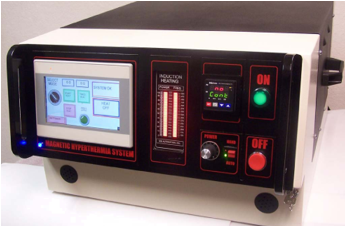
    MagneTherm™ Magnetic Fluid Hyperthermia Analysis System
    The MagneTherm™ Magnetic Fluid Hyperthermia Analysis System uses alternating magnetic fields (AMF) and magnetic nanoparticles (MNPs) as a heating method for tumors and other cells. By applying an alternating magnetic field of a certain strength, the magnetic particles can absorb electromagnetic energy and convert it into heat. The system controls the heat to be confined within the tumor tissue, leading to apoptosis and necrosis of cells, thus achieving hyperthermia treatment and related studies for tumors. This system can also control the tissue targeting and cell-specific targeting of the magnetic nanofluid, enabling extracellular and intracellular multiparametric magnetic fluid hyperthermia analysis.

    System Principle
    By controlling nanoscale magnetic particles to locate within tumor tissues, and then applying an external alternating magnetic field, the materials are heated due to magnetic hysteresis, relaxation, or induced eddy currents. The generated heat is transferred to the surrounding tumor tissue, increasing the temperature above 42°C, leading to apoptosis and necrosis of tumor cells, thereby achieving tumor treatment.
    The main principles by which the MagneTherm™ magnetic fluid hyperthermia testing system kills tumor cells are:
    (1) High temperatures alter the fluidity of the mitochondrial membrane in tumor cells, damaging the enzymes necessary for DNA synthesis and causing cell death. Heat also lowers the pH value of tumor tissues, enhancing the cytotoxic effects.
    (2) Tumor blood vessels are irregular and have low heat dissipation capacity, increasing the selectivity of hyperthermia for tumor tissue and enhancing NK cell activity. NK cells can kill tumor cells without being activated by tumor antigens. Their cytotoxic effect is mainly achieved by binding their surface tumor cell receptors to the tumor cells and releasing cytolysins.
    (3) It promotes the maturation of dendritic cells (DCs). Immature dendritic cells are precursors of mature dendritic cells and have strong antigen uptake capabilities. However, due to their low expression of MHC I, II and co-stimulatory molecules, they cannot effectively present antigens to T lymphocytes, resulting in reduced T cell stimulation. Mature dendritic cells can significantly stimulate initial dendritic cells to proliferate, making dendritic cells the initiators of immune responses.
    (4) Magnetic fluid hyperthermia can also increase the expression of MHC I on tumor cell surfaces, thereby activating T cell-mediated anti-tumor immune responses.

    The figure above compares the heating performance of magnetic fluids (Fe3O4) at different concentrations in an alternating magnetic field.
    Product Advantages
    This MagneTherm™ system exceeds the safe and tolerable magnetic field dosage and is highly flexible, allowing researchers to change frequency and field strength as needed for different cell and tissue systems. It enables magnetic fluid hyperthermia analysis of cells (adherent or suspended) and 3D cell culture systems.
    Ten different standard frequencies, ranging from 50 kHz to 1 MHz
    Including 110 kHz, 168 kHz, 176 kHz, 262 kHz, 335 kHz, 474 kHz, 523 kHz, 633 kHz, 739 kHz, 987 kHz
    Magnetic field strength up to 25 mT, adjustable
    Excellent thermal insulation
    Compatible with PCR vials or small tubes (volumes from 1 mL to 50 mL)
    Can operate with 35 mm culture dishes (biofilm/cell/3D tissue culture)
    Desktop unit with minimal footprint
    Lightweight low-temperature cooling system without bulky attachments

    Application Fields
    Small Animal Tumor Therapy Research
    Existing studies have shown that magnetic hyperthermia can achieve effective targeted intratumoral therapy, unaffected by tumor size or location. In recent years, the discovery of the "thermal bystander" effect of magnetic hyperthermia has attracted widespread attention. Various magnetic materials used for hyperthermia have become a research hotspot globally.

    Heat Shock Protein Research
    Combining hyperthermia with chemotherapy drugs can enhance immune function while avoiding the toxic side effects of radiotherapy and chemotherapy. Heat shock proteins (HSPs), particularly HSP70, mainly participate in the processing and presentation of tumor antigens. They can directly present tumor antigen peptides to T cells as antigen-presenting molecules, activating T cell-mediated cellular immunity. The interaction between immune capacity and tumors is mutual: the immune system affects tumor development, and tumors can alter immune function. In the treatment of malignant tumors, besides surgery, chemotherapy and radiotherapy are the main methods. However, due to drug resistance and dose limitations, these treatments can also damage normal tissues and cells, potentially causing life-threatening complications.
    Drug Release Control Research
    Controlled drug release technologies ensure slow and sustained efficacy, maintaining optimal drug concentrations in the blood to achieve the best therapeutic effect. Their advantages include better absorption and metabolism of drugs and optimized therapeutic effects. By using specially designed magnetic nanoparticles to carry drugs, drug release can be better controlled. The system enables drug penetration into solid tumors, and when combined with magnetic fluid hyperthermia analysis, it allows targeted drug release to kill cancer cells precisely at the targeted site.

    Biofilm Treatment Mediated by Magnetic Nanoparticles
    Bacterial colonies attach to surfaces and form biofilms by secreting extracellular polymeric substances. Biofilm formation provides antibiotic resistance and promotes the development of chronic infections. The application of superparamagnetic iron oxide nanoparticles (SPIONs) significantly reduces the risk of biomaterial-associated infections. The magnetic targeting ability of SPIONs allows them to penetrate biofilms. Using an alternating magnetic field to heat the particles reduces bacterial colony viability. This approach is particularly effective against antibiotic-resistant strains and biofilms, showing great promise in treatment.
    Magnetic Fluid Nanoparticle Types in Use Include:
    Surface-functionalized magnetite (Fe3O4)
    Silver-coated hematite (iron oxide)
    Magnetite (Fe3O4)
    Cobalt-doped magnetite
    Iron core/iron oxide shell nanoparticles
    Gold-coated hematite (iron oxide)
    Iron oxide nanocrystals (IONCs)
    Colloidal greigite (Fe3S4) nanosheets
    Detailed Specifications
    System Components
    Includes DC power supply system, function signal generator, oscilloscope, etc.
    DC Power Supply System: 24 cm (W) × 32 cm (D) × 13 cm (H)
    Weight: 6 kg
    Function Signal Generator: 22 cm (W) × 29 cm (D) × 10 cm (H)
    Weight: 2.8 kg
    Oscilloscope: 35 cm (W) × 44 cm (D) × 17 cm (H)
    Weight: 8 kg
    Main Accessories
    17-turn coil
    9-turn coil
    Thermocouple adapter with multimeter function
    Oscilloscope
    Function signal generator
    Temperature probe (T-type thermocouple)
    DC regulated power supply
    Polystyrene sample tubes
    Tubing and gaskets
    Cooling water connecting tubes
    Connection cables
    Table 1: Frequencies and Magnetic Field Strengths Provided by the System

    Note: All field strengths can be adjusted by the operator from the maximum down to zero.

    Above: Winding method of 17-turn and 9-turn coils
    Optional Accessories:
    Larger sample coil box (60 mm)
    Low-frequency accessories: 90 kHz, 87 kHz, 70 kHz, 64 kHz, 50 kHz
    Water-jacketed sample aperture (commonly used for in vivo applications)
    Dual-channel optical fiber signal processor and temperature probes